What are you getting done?
Tap one. Deterministic — the rules on this page, not a guess.
Check the registration or licence on WA’s online licence search before work starts. Builders, electricians, plumbers and gas fitters are all on it.
Check their licence on the WA register →Still looking? Find someone near you → Check their current licence with Building and Energy before hiring.
The three-part test, in one table
Western Australia does not have a single number. It has a checklist, and Building and Energy publishes it as one:
| # | The question | What makes it a yes |
|---|---|---|
| 1 | Does the work need a building permit? | Construction, renovation, alteration, extension, improvement or repair of a building, relocating one, or the ground works that go with it. Your local government permit authority decides |
| 2 | Is it worth enough? | $50,000 or more for a Class 10a building — a garage, carport, shed or the like. $20,000 or more for every other kind of building work |
| 3 | Is it inside the prescribed area? | The prescribed area covers 122 of WA's local governments. In some low-population areas, only the major town sites are inside it |
All three, or none. Building and Energy states it plainly: “If you answered 'no' to any of the above questions, registration as a building contractor is NOT required.” That is unusual, and it is the reason a Perth answer and a remote-shire answer to the same question can differ.
Source: Government of Western Australia, Do I need to be a registered building contractor?, read 3 September 2026 (that page states it was last updated 24 July 2026). Building and Energy is the authority on its own rules — if your job sits near a line, ask them, not us.
When registration is not required
Two exemptions matter to an ordinary homeowner, and one of them explains something you will actually see on site.
- An employee or subcontractor of a registered building contractor, where that contractor is supervising the work and is named as the builder on the building permit. So the sparky, the tiler and the chippie on a registered builder's job are not each separately registered as contractors — the builder named on the permit is.
- Work that fails any one of the three tests above — under the value, outside the prescribed area, or not requiring a permit.
Read the first one carefully before relaxing about it. It only works if there is a registered building contractor named on the permit and supervising. A subcontractor working directly for you, on a job over the threshold, is not covered by somebody else's registration.
Check a WA registration at the regulatorHome indemnity insurance runs on its own $20,000
This is a separate rule with a similar number, and confusing the two is easy. Home indemnity insurance is required for all building work requiring a building permit and valued at more than $20,000. There is no Class 10a carve-out in it and no area test in the sentence WA publishes.
| Home indemnity insurance | What WA publishes |
|---|---|
| When it is required | All building work requiring a building permit, valued at more than $20,000 |
| What triggers a claim | The death, disappearance or insolvency of your builder |
| Loss of deposit | Up to $40,000 |
| Incomplete or defective building work | Up to $200,000 |
| What you should be given | A copy of the certificate, from your builder |
Source: Government of Western Australia, Building or renovating your home, read 3 September 2026 (last updated 2 September 2026 per that page).
Your contract is protected whether or not the builder is registered
This one surprises people, and it cuts in your favour. WA states that your rights under the Home Building Contracts Act 1991 apply to fixed-cost home-building contracts between $7,500 and $500,000, and that they apply “whether or not your builder is a registered builder”.
Home-building work there means a new home, renovating, repairing or altering an existing one, or putting a new home on a block — plus the associated work: a pool, cabinetry, tiling, a garage, a shed, a pergola, landscaping.
And there is a document you are owed before you sign. Your builder must give you a copy of the Notice for the homeowner, which sets out their obligations and your protections. If nobody has handed you one, that is a question, not a formality.
Source: Government of Western Australia, Building or renovating your home, read 3 September 2026.
The registration threshold is not the rule for the sparky or the plumber
Electrical, gas and plumbing work in Western Australia is licensed separately, and none of the three tests above applies to it. There is no version of “too small to need a licence” for work that can electrocute somebody or contaminate the drinking water.
The national picture, with each regulator's own wording beside it, is here: electrical and plumbing work always needs a licence, whatever it costs.
Three questions worth asking before you say yes
- “Does this job need a building permit?” It is test one, and your local government permit authority is the only body that can answer it. Ask them, not the builder, if there is any doubt.
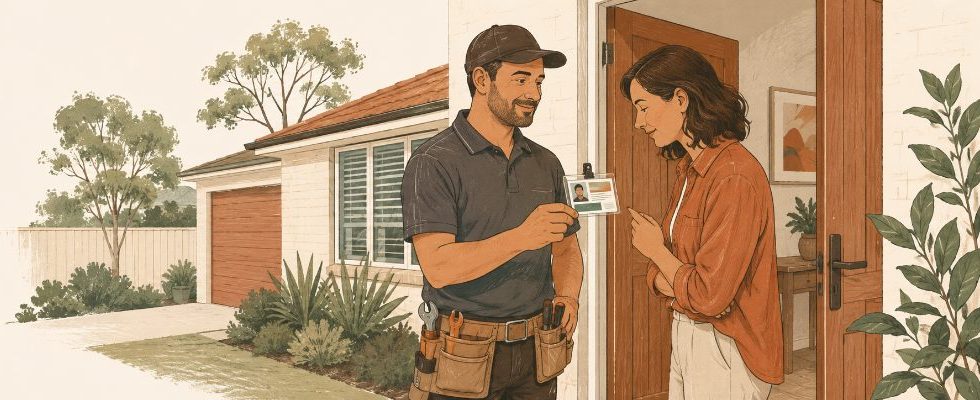
- “What is your registration number?” A number can be searched. A photo cannot be checked, and anyone can make one.
- “Is the home indemnity insurance in place, and can I see the certificate?” Ask before the deposit. WA's own advice is not to pay anything until it is.
Check it before the work starts
WA's register is public and free. The how-to for every state and territory is here: how to check a tradie's licence yourself.
This page explains what the Western Australian Government publishes about builder registration and home indemnity insurance. It is general information, not legal advice, and it is not a licence check. Yamate is software for tradespeople. We do not issue, assess, endorse or certify any licence or registration, and we do not decide whether one is required for your job — Building and Energy does, and your local government permit authority decides whether a permit is required. No regulator has reviewed this page. Every figure above was read at the government's own pages on 3 September 2026 and is linked beside the claim; thresholds, limits and department names change, so check the date here against theirs. Western Australia only — the numbers here do not apply in any other state.