What are you getting done?
Tap one. Deterministic — the rules on this page, not a guess.
Check the licence number at Service NSW before work starts. It shows the class, the expiry and any conditions.
Check their licence at Service NSW →Still looking? Find someone near you → Check their current licence with NSW Fair Trading before hiring.
When a licence is needed, and when it is not
| The work | Licence needed? | The line |
|---|---|---|
| Residential building or trade work — kitchens, bathrooms, garages, carports, sheds, pools, cladding | YES — licence required | Valued over $5,000 in labour and materials, including GST |
| The same work at or under $5,000 | NO — contractor licence required | Unless any part of it is specialist work, below |
| Electrical wiring work | YES — licence required | Any value. No dollar threshold exists |
| Plumbing, draining, gasfitting | YES — licence required | Any value. No dollar threshold exists |
| Air conditioning and refrigeration; medical gas and mechanical services | YES — licence required | Any value. No dollar threshold exists |
| A subcontracted part of a larger job | YES — licence required | Where it forms part of a contract worth more than $5,000 |
Sources: NSW Government, General building work and Categories of work, both read 3 September 2026. NSW Fair Trading is the authority on its own thresholds — if your job sits near a line, ask them, not us.
The $5,000 line does not reach the sparky or the plumber
This is the mix-up worth spending thirty seconds on. Building work is licensed on what the job is worth. Specialist work is licensed on what it can do to you, so there is no dollar figure in it at all — NSW writes the words “regardless of the cost of the work” into its own guidance.
One powerpoint is the same rule as a whole-house rewire. A single tap that is plumbed in, rather than screwed on, is the same rule as a bathroom. A quote for $400 does not buy an exception, and neither does a mate doing you a favour.
The national version of that rule, with the other states' wording beside it, is here: electrical and plumbing work always needs a licence, whatever it costs.
Check a NSW licence at the regulatorAt $20,000 a second thing switches on
Home Building Compensation cover — HBCF, run by icare — is a separate requirement with a separate number. It is required for most residential building projects over $20,000 including GST, unless the project is exempt.
The timing is the part that protects you. icare states the builder must hold the cover “before you start work, or take any payment for the project, including a deposit.” So a request for a deposit on a $30,000 job, with no certificate in sight, is a question to ask before you transfer anything — not after.
Source: icare, Do I need HBCF?, read 3 September 2026.
What unlicensed work costs the person who does it
NSW publishes the penalty on the same page as the threshold: $22,000 for an individual and $110,000 for a company, under the Home Building Act 1989, for doing unlicensed work.
That figure is not there to frighten you, and it is not your exposure. It is there because it tells you how seriously the state treats the line — and because a tradie who shrugs at it is telling you something about how they will treat the rest of the job.
Source: NSW Government, General building work, read 3 September 2026.
How the value of the work is worked out
NSW is clearer than most on this one. The figure is labour and materials together, including GST — not the labour line on the quote, and not the ex-GST subtotal. That wording is on the page that states the threshold.
What it means in practice: a $4,800 quote that grows a bit in the middle has crossed the line, and a job split into two smaller invoices is still one job. If a quote lands anywhere near $5,000, treat it as though the threshold applies and ask for the licence number. If it genuinely matters — a big deposit, a dispute brewing — ring NSW Fair Trading about your specific job. That call is free and it is the only answer that binds anyone.
Three questions worth asking before you say yes
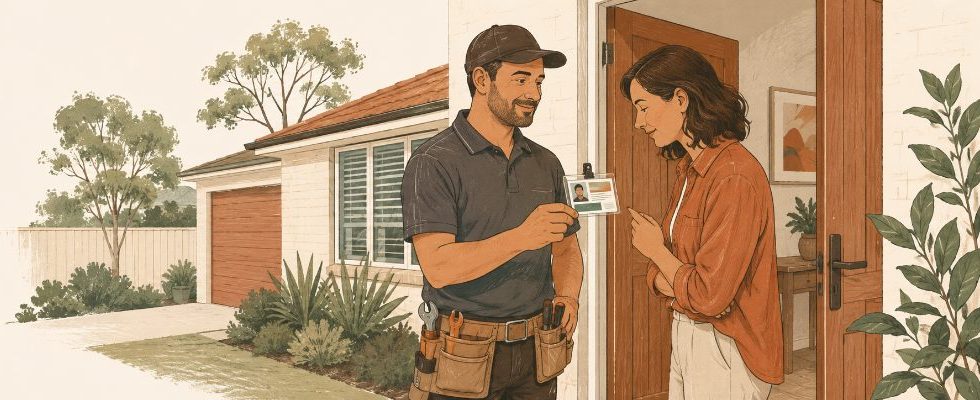
- “What is your licence number, and what class is it?” A number can be searched on your own phone in a minute. A photo of a card cannot be checked, and anyone can make one.
- “Is this job over $5,000 all up, labour and materials with GST?” If yes, the contractor licence is required. If it is close, treat it as though it is.
- “Who is doing the electrical and the plumbing?” On a job with several trades, the person quoting you is often not the person doing the licensed parts. Get those names too, then check those.
Check it before the work starts
A licence you check afterwards is a licence you checked too late. The NSW register is public, free, and takes about a minute; a licensed tradie will hand you the number without being asked twice.
We are not going to rewrite the how-to here, because we already have one that covers every state and territory: how to check a tradie's licence yourself.
This page explains what the NSW Government publishes about licence thresholds. It is general information, not legal advice, and it is not a licence check. Yamate is software for tradespeople. We do not issue, assess, endorse or certify any licence, and we do not decide whether a licence is required for your job — NSW Fair Trading does. No regulator has reviewed this page. Every figure above was read at the government's own page on 3 September 2026 and is linked beside the claim; thresholds, penalties and rules change, so check the date on this page against theirs. New South Wales only — the numbers here do not apply in any other state.